Industry
The Drone Revolution: From Flying Machines to a New Global Aviation Workforce
The next challenge is not teaching more people to fly drones. It is training the operators, maintainers and regulators who turn hardware into capability.
Noor Abbas MirzaAviation professional, Strategic business development practitioner08 Sept 20265 min read
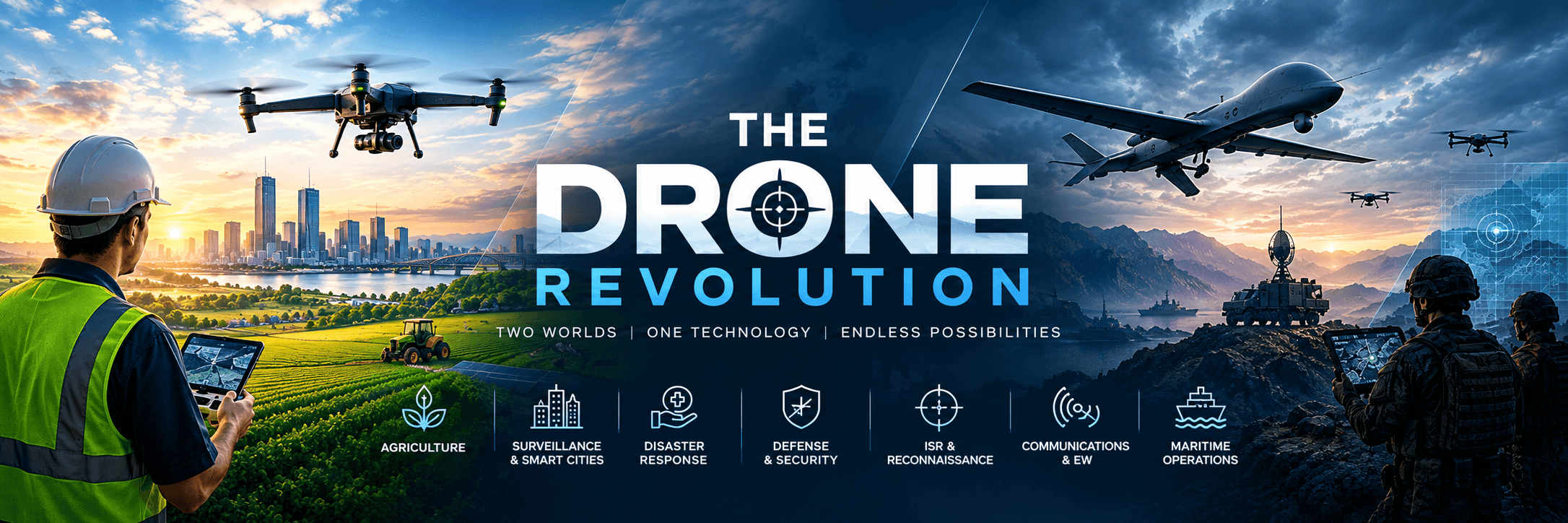
The drone industry is no longer a niche technology market reserved for hobbyists, photographers or military laboratories. Unmanned Aircraft Systems (UAS) have rapidly evolved into an important component of the global aviation, security, logistics, agriculture, infrastructure and defense ecosystem.
From precision agriculture and infrastructure inspection to emergency response, mapping, filmmaking, logistics, border surveillance and military intelligence, drones are increasingly performing missions that were traditionally expensive, dangerous or difficult to execute with manned aircraft.
The transformation is significant: the world is not merely buying more drones. It is building an entirely new UAS operating ecosystem around them.
And that ecosystem requires something more important than hardware—competent people.
From Hobby Aircraft to Professional Aviation System
The modern drone should no longer be viewed simply as a remotely controlled aircraft.
A professional UAS operation involves an aircraft, propulsion system, flight-control system, navigation, communications, sensors, data links, ground-control station, software, maintenance processes, operational procedures, trained personnel and a regulatory framework.
This is why international aviation authorities increasingly approach drones through a risk- and competency-based model.
The International Civil Aviation Organization (ICAO), for example, emphasizes that remote-pilot competency should correspond to the risk of the operation. Its guidance identifies progressively higher requirements ranging from basic training for very low-risk operations to theoretical and practical training for higher-risk activities. It also identifies aviation knowledge such as airspace, meteorology, navigation, communications, regulations and operational procedures as important components of professional remote-pilot competence.
This represents a fundamental shift.
The question is no longer:
“Can you fly a drone?”
The professional question is:
“Can you conduct a safe, legal, repeatable and mission-effective UAS operation?”
Civil Aviation Is Becoming a Major Drone Market
Civil applications are expanding across multiple sectors.
Agriculture is using drones for crop monitoring, multispectral imaging, field surveying and precision application. Construction companies use them for progress monitoring, volumetric measurement and site inspection. Energy companies employ UAS for inspection of pipelines, power infrastructure, solar farms and wind turbines.
Emergency services can use drones for search and rescue, disaster assessment and situational awareness. Surveying and geospatial organizations use them for mapping and photogrammetry. Media organizations have transformed aerial photography and videography through small, relatively inexpensive UAS platforms.
Logistics represents another major area of development, particularly as regulators and industry work toward more complex operations, including Beyond Visual Line of Sight (BVLOS).
The European Union's regulatory framework illustrates this progression. EASA classifies civil drone operations into Open, Specific and Certified categories according to operational risk. Higher-risk operations can require operational authorization, risk assessment and, in the certified category, certification of the aircraft/operator and licensing of remote pilots.
This means the commercial drone sector is gradually becoming an aviation profession rather than simply a technology hobby.
The Military Has Accelerated the Transformation
The military dimension is even more profound.
Recent conflicts have demonstrated how relatively inexpensive unmanned systems can provide persistent surveillance, reconnaissance, targeting support, communications, logistics and other battlefield capabilities.
The military UAS ecosystem ranges from small hand-launched systems to sophisticated long-endurance platforms. At the tactical level, small drones can provide units with an organic observation capability. At operational and strategic levels, larger systems can support intelligence, surveillance and reconnaissance missions.
The proliferation of commercial components has also reduced barriers to entry for UAS development. Sensors, processors, communications equipment, navigation systems, batteries, propulsion technologies and software are increasingly available through a global industrial ecosystem.
Consequently, military organizations are not simply acquiring aircraft. They are developing UAS operators, mission planners, maintenance personnel, intelligence specialists, data analysts, instructors and commanders who understand unmanned operations. The human element remains decisive.
Ground Training Is the Foundation
The most effective UAS training architecture should begin on the ground.
Before a student performs sophisticated flight operations, he or she should understand the environment in which the aircraft operates.
The Opportunity for Emerging Markets
Countries with large agricultural sectors, developing infrastructure, extensive geographic areas and growing security requirements have particularly strong potential for UAS adoption.
For Pakistan, the opportunity is especially broad.
Agriculture can use UAS for crop monitoring and precision agriculture. Urban authorities can use them for surveying and infrastructure monitoring. Disaster-management organizations can employ them for rapid assessment after floods, earthquakes and other emergencies.
The construction, mining, energy, telecommunications and environmental sectors can develop dedicated UAS inspection capabilities.
At the same time, universities and technical institutes can establish UAS programmes that combine aviation, engineering, GIS, cybersecurity, data science and operational management.
This creates an important economic possibility:
Pakistan does not have to be only a consumer of drone technology. It can develop a trained UAS workforce capable of supporting a domestic drone industry.
The Future: From Drone Pilots to UAS Professionals
The next phase of the drone industry will therefore be defined less by the number of aircraft sold and more by the quality of the ecosystem surrounding them.
The industry will need standardized training, qualified instructors, competent operators, maintenance systems, operational manuals, safety-management processes, cybersecurity controls, airspace integration and regulatory compliance.
This is where the drone market becomes particularly interesting for educational and professional institutions.
A teenager may begin with a basic recreational drone course.
That student can progress into a remote-pilot programme.
The remote pilot can then specialize in agriculture, surveying, inspection, cinematography, emergency response or industrial operations.
With additional experience, the professional can move into mission management, UAS safety, instruction, fleet operations or regulatory compliance.
In other words, a drone can become the entry point into an entire aviation career.
The global drone revolution is no longer primarily about aircraft. It is about capability.
The aircraft is only one component of that capability. The real operational advantage comes from the combination of technology, people, procedures, training, data and disciplined risk management.
Civil aviation is integrating drones into increasingly sophisticated operations. Military organizations are expanding their use of unmanned systems across multiple levels of operations. Regulators are developing risk-based frameworks. International standards are beginning to formalize UAS training and competency.
The logical next step is therefore to build a structured pipeline of UAS education:
Awareness → Basic Ground Training → Remote Pilot → Professional Operator → Specialized Mission Training → UAS Management and Safety
That pipeline can transform drone technology from a consumer product into a professional capability.
The drone age is already here.
The next challenge is not teaching more people to fly drones.
It is teaching them to operate unmanned aircraft professionally, safely, legally and intelligently.

Aviation professional, Strategic business development practitioner
Noor Abbas Mirza
Writer
Aviation professional, strategic business development practitioner with experience spanning Aerospace & Defense Procurement, AVSEC, INFOSEC, CyberSEC, Quality, Compliance & Due Diligence Management