Industry
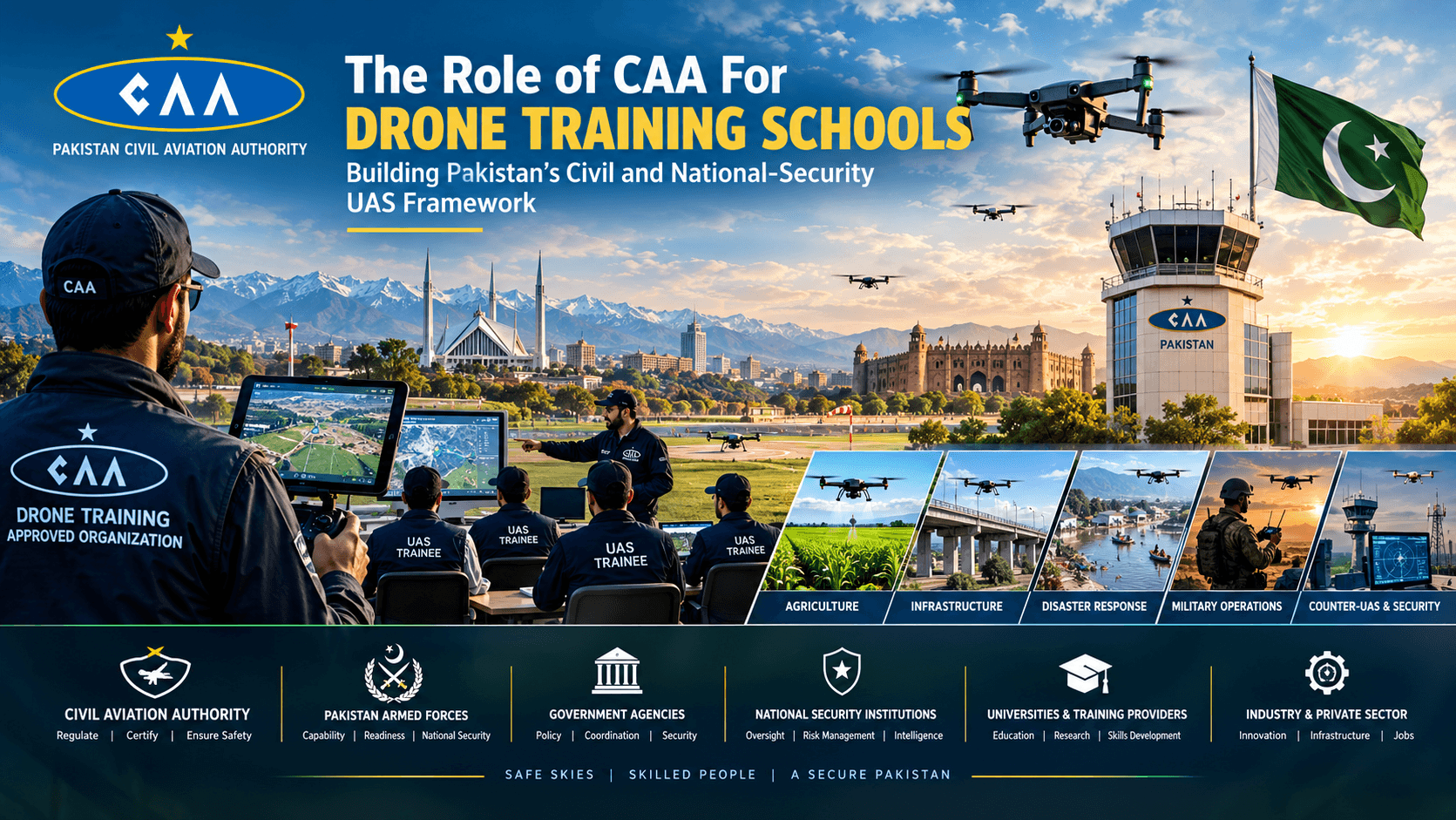
The Role of CAA For Drone Training Schools: Building Pakistan’s Civil and National-Security UAS Framework
Pakistan’s drone revolution requires more than aircraft, operators and technology it requires a coordinated regulatory and security framework. This article examines how the CAA, Armed Forces, national-security institutions, industry and training providers can work together to build a professional, secure and future-ready UAS workforce for Pakistan’s civil and military sectors.
Noor Abbas MirzaAviation professional, Strategic business development practitioner22 Sept 20268 min read
Pakistan is entering a new phase of the drone revolution.
Unmanned Aircraft Systems (UAS) are rapidly moving beyond recreational photography and limited commercial applications. They are becoming relevant to agriculture, surveying, infrastructure inspection, disaster management, logistics, environmental monitoring, emergency response, aviation, security and national defence.
At the same time, recent conflicts have demonstrated the growing strategic importance of unmanned systems in modern warfare. Pakistan's Ministry of Defence Production stated in May 2026 that recent global conflicts had demonstrated the significant role of drones in warfare, intelligence gathering, border monitoring and precision operations, and described the development of indigenous unmanned capabilities as a national priority.
This creates a requirement that is often overlooked:
Pakistan does not only need a drone industry. Pakistan needs a regulated, competent and security-conscious drone workforce.
And that workforce will require professional training institutions.
The question, therefore, is not simply who can operate a drone.
The more important question is:
Who should be allowed to train drone operators, under what standards, with what security controls, and under whose regulatory authority?
The CAA's Role in the Emerging UAS Training Ecosystem
Civil aviation regulation should remain the foundation of Pakistan's civilian drone-training framework.
Pakistan's Civil Unmanned Aircraft Rules, 2024 established a formal regulatory basis for unmanned aircraft registration and operation. Reporting on the rules indicates that the Civil Aviation Authority was assigned responsibility for drone registration and that certain categories require remote-pilot licensing.
This creates an important principle:
If the regulator is responsible for the safety and licensing of civil UAS operations, it must also have a meaningful role in assuring the quality of the institutions that train those operators.
A training school should therefore not simply be treated as an ordinary private educational business.
A professional UAS training organization should be recognized as part of the aviation safety system.
Its instructors, training aircraft, facilities, procedures, examinations, maintenance arrangements, operational areas and student records should all be subject to appropriate regulatory oversight.
From “Drone Academy” to Approved UAS Training Organization
Pakistan should consider establishing a formal category such as:
Approved UAS Training Organization (UATO)
or an equivalent regulatory designation.
The objective would be to distinguish a professionally regulated aviation training organization from a commercial entity offering informal drone-flying courses.
An approved UAS training organization could be required to demonstrate:
Qualified instructors
Approved training syllabi
Defined theoretical instruction
Practical flight training
Safety-management procedures
Aircraft maintenance arrangements
Student assessment procedures
Instructor competency requirements
Training-record management
Operational risk assessments
Approved training locations
Emergency procedures
Insurance and liability arrangements
Regulatory compliance
Security controls
This would create a professional baseline for Pakistan's emerging UAS education sector.
The Training School Should Not Be Regulated Only by the Number of Drones
One of the weaknesses of a simplistic licensing system would be to classify training schools only according to the number or weight of drones they operate.
A better approach would consider the nature of the training.
For example, a basic civilian UAS school may provide introductory remote-pilot education.
A professional commercial school may train personnel for surveying, agriculture, infrastructure inspection and other specialized applications.
An advanced UAS academy may provide instruction involving complex systems, advanced sensors, data processing, automated operations and specialized mission management.
These categories should not necessarily be treated identically.
Pakistan needs a risk-based training-organization approval system.
The greater the operational complexity and sensitivity of the training, the greater the requirements for facilities, instructors, security, documentation and regulatory oversight.
The Security Dimension
Drone training cannot be treated entirely as an ordinary aviation matter.
A UAS is an aircraft, but it is also a sensor platform, communications system and data-collection device.
Consequently, an institution training hundreds of future UAS professionals potentially becomes part of a national technology ecosystem.
This does not mean that every civilian drone student should be treated as a security risk.
It means that Pakistan should establish sensible risk-based security controls.
There should be a clear distinction between:
Ordinary civilian UAS training
and
Sensitive or security-related UAS training.
The first should remain accessible under normal civil aviation regulation.
The second should involve additional authorization and coordination with the relevant national-security institutions.
A Whole-of-Government Approach
The development of Pakistan's drone workforce should not become the responsibility of one organization alone.
A mature framework would require coordination between multiple institutions, each operating within its lawful mandate.
Civil Aviation Authority
The CAA should remain responsible for the civil aviation aspects of UAS training, including appropriate licensing, training standards, instructor requirements, examinations, operational safety and regulatory compliance.
The CAA should also maintain a national register of approved civil UAS training organizations and qualified instructors.
Aviation Division
The Aviation Division should provide the federal policy framework and coordinate aviation-related responsibilities across government.
Pakistan's Rules of Business assign federal responsibilities relating to aircraft and air navigation, civil aviation development, and regulation and safety of air traffic and aerodromes to the aviation portfolio.
Ministry of Defence and Armed Forces
The military dimension requires a separate but coordinated framework.
The Pakistan Army, Pakistan Navy and Pakistan Air Force have distinct operational responsibilities and should retain control over military-specific UAS training, doctrine and operational requirements within their respective institutional structures.
Civilian UAS training institutions should not attempt to replicate military training authorities.
Instead, the national framework should provide mechanisms through which approved civilian institutions can contribute to the broader UAS talent pipeline where government policy permits.
This could include areas such as aviation fundamentals, engineering, maintenance, GIS, remote sensing, safety management, data analysis and other dual-use competencies.
Ministry of Defence Production
The Ministry of Defence Production has an important role in connecting industry, research, domestic manufacturing and national defence requirements.
Its 2026 engagement with private UAS developers specifically emphasized coordination between public institutions and private companies, together with testing infrastructure, procurement mechanisms, research support and regulatory procedures.
This makes the training sector an important part of the broader defence-industrial ecosystem.
Ministry of Interior and Internal-Security Institutions
Civil UAS expansion also has an internal-security dimension.
The Ministry of Interior, relevant law-enforcement organizations and appropriate national security institutions should have defined mechanisms for addressing security-sensitive UAS activities, particularly where operations involve protected locations, critical infrastructure or other nationally sensitive environments.
The objective should not be to create unnecessary bureaucracy.
It should be to ensure that civil aviation licensing and national-security requirements do not operate in isolation.
NACTA and Law-Enforcement Agencies
Pakistan's national-security architecture already emphasizes multi-agency coordination.
The National Action Plan's implementation has involved federal and provincial governments, services chiefs, chief secretaries and civilian, military and law-enforcement institutions.
The same principle can inform UAS governance.
Where drone operations intersect with internal security, counterterrorism, critical infrastructure protection or law enforcement, appropriate information-sharing and coordination mechanisms should exist.
Airports Security Force
The Airports Security Force has a specific aviation-security role and should be incorporated into the national UAS coordination framework where drone activities affect protected airport environments.
The federal administrative structure places ASF within the aviation portfolio alongside the CAA.
This becomes increasingly important as drone activity grows around airports and other aviation infrastructure.
Security Clearance Should Be Risk-Based
One of the most important policy questions is whether every drone instructor or trainee should undergo extensive security clearance.
A blanket approach would risk making civilian UAS education unnecessarily difficult.
A completely unrestricted approach could create avoidable security vulnerabilities.
Pakistan therefore needs a tiered security model.
For example:
Tier 1 — General Civil UAS Training
Basic commercial, recreational and educational training conducted under ordinary CAA requirements.
Tier 2 — Professional UAS Training
Training involving commercial operations, specialized payloads, advanced mapping, infrastructure inspection or other higher-risk activities.
Tier 3 — Sensitive UAS Training
Training involving security-sensitive operations, restricted environments, government requirements or other activities designated by the competent authority.
Tier 4 — Military UAS Training
Training conducted under the authority of the Armed Forces and applicable defence-security frameworks.
This would prevent the civil aviation system from becoming unnecessarily restrictive while maintaining appropriate national-security controls.
The Instructor Is More Important Than the Aircraft
Pakistan should also reconsider what constitutes a qualified UAS instructor.
Owning an advanced drone does not make someone an aviation instructor.
A professional UAS instructor should demonstrate appropriate knowledge of:
Aviation principles
UAS systems
Flight safety
Airspace awareness
Human factors
Weather considerations
Emergency procedures
Mission planning
Regulatory requirements
Aircraft limitations
Maintenance fundamentals
Risk management
Instructional methodology
For advanced courses, instructors may additionally require demonstrated competency in areas such as GIS, remote sensing, data processing, systems engineering or UAS cybersecurity.
The regulatory system should therefore assess instructor competence, not merely aircraft ownership.
Training Locations Need Formal Approval
The location where UAS training takes place should also form part of the licensing process.
A training organization should demonstrate that its operational area is appropriate for the intended training activity.
The approval process should consider:
Airspace environment
Proximity to airports
Population density
Nearby critical infrastructure
Environmental considerations
Emergency-response arrangements
Communications
Weather conditions
Recovery procedures
Local permissions
This does not mean that every drone flight should require an individual bureaucratic approval.
The better approach is to establish approved training areas and operating frameworks wherever practical.
That would allow legitimate training organizations to operate efficiently while maintaining airspace safety and security.
Training Records Should Become Part of the National UAS System
A professional UAS sector requires traceability.
Pakistan should consider establishing a centralized or interoperable digital system covering:
Training organizations
Instructors
Remote pilots
Certificates
Examinations
Aircraft used for training
Training hours
Recurrent training
Competency assessments
Suspensions and enforcement actions
Such a system would help prevent fraudulent certificates and make professional qualifications easier to verify.
It would also provide government with better visibility of the national UAS workforce.
Civil and Military Training Should Remain Distinct
There is a temptation to create one universal drone-training system for both civil and military applications.
That would be inappropriate.
Military aviation and civil aviation have different operational requirements, authorities and security frameworks.
The better model is:
Separate authorities, common foundations.
Civilian UAS training can provide strong foundations in aviation, engineering, safety, data and systems management.
Military institutions can retain responsibility for military-specific doctrine, operational training and security-sensitive competencies.
Where appropriate, the two ecosystems can exchange knowledge through controlled academic, research and industrial partnerships.
This would allow Pakistan to develop a broad national UAS talent pool without compromising the distinct responsibilities of civilian aviation and the Armed Forces.
The CAA Should Become More Than a Licensing Office
The drone revolution gives Pakistan's civil aviation regulator an opportunity to evolve.
The regulator should not merely issue certificates.
It should help establish an aviation safety culture for the unmanned sector.
That means developing:
UAS training standards
Instructor standards
Examination standards
Safety-management requirements
Training-organization approval criteria
Audit programs
Continuing competency requirements
Incident-reporting mechanisms
Compliance monitoring
Digital licensing systems
The CAA could also establish an expert UAS advisory mechanism involving universities, industry, aviation professionals, technical specialists and relevant government stakeholders.
The purpose would be continuous regulatory development.
Drone technology is changing too quickly for static regulations to remain effective for long periods.

Aviation professional, Strategic business development practitioner
Noor Abbas Mirza
Writer
Aviation professional, strategic business development practitioner with experience spanning Aerospace & Defense Procurement, AVSEC, INFOSEC, CyberSEC, Quality, Compliance & Due Diligence Management