Aerospace
The Human Capital Required and Far Beyond the Drone Revolution
Pakistan’s drone revolution will require far more than aircraft and operators. As unmanned systems reshape civil aviation, industry and modern warfare, the country must develop a skilled UAS workforce capable of designing, operating, maintaining, regulating, securing and integrating these systems. The real strategic advantage will belong not simply to those who possess drones, but to those who possess the human capital to turn them into sustainable national capability.
Noor Abbas MirzaAviation professional, Strategic business development practitioner12 Sept 20264 min read
The global drone revolution is entering a new phase.
Unmanned Aircraft Systems or generally known as Drone are no longer simply remotely controlled flying machines used for photography, surveying or limited military missions. They are becoming part of a much larger aviation, technology and security ecosystem one involving autonomous systems, artificial intelligence, geospatial intelligence, data analytics, airspace management, cybersecurity, logistics, agriculture, infrastructure monitoring and modern military operations.
For Pakistan, this transformation presents both an opportunity and a strategic requirement.
The country does not simply need more drones.
Pakistan needs a drone workforce.
The distinction is important.
A fleet of sophisticated unmanned aircraft is of limited value without trained personnel capable of planning missions, operating systems safely, maintaining airworthiness, interpreting data, managing airspace, ensuring regulatory compliance, protecting digital infrastructure and integrating Drone into larger organizational operations.
This is why Pakistan's future drone strategy should be viewed not only as an aerospace or defense-industry question, but also as a human-capital question.
From Drone Operators to a Professional Drone Workforce
The traditional perception of a drone operator is relatively simple: someone controlling an aircraft from the ground.
That model is rapidly becoming outdated.
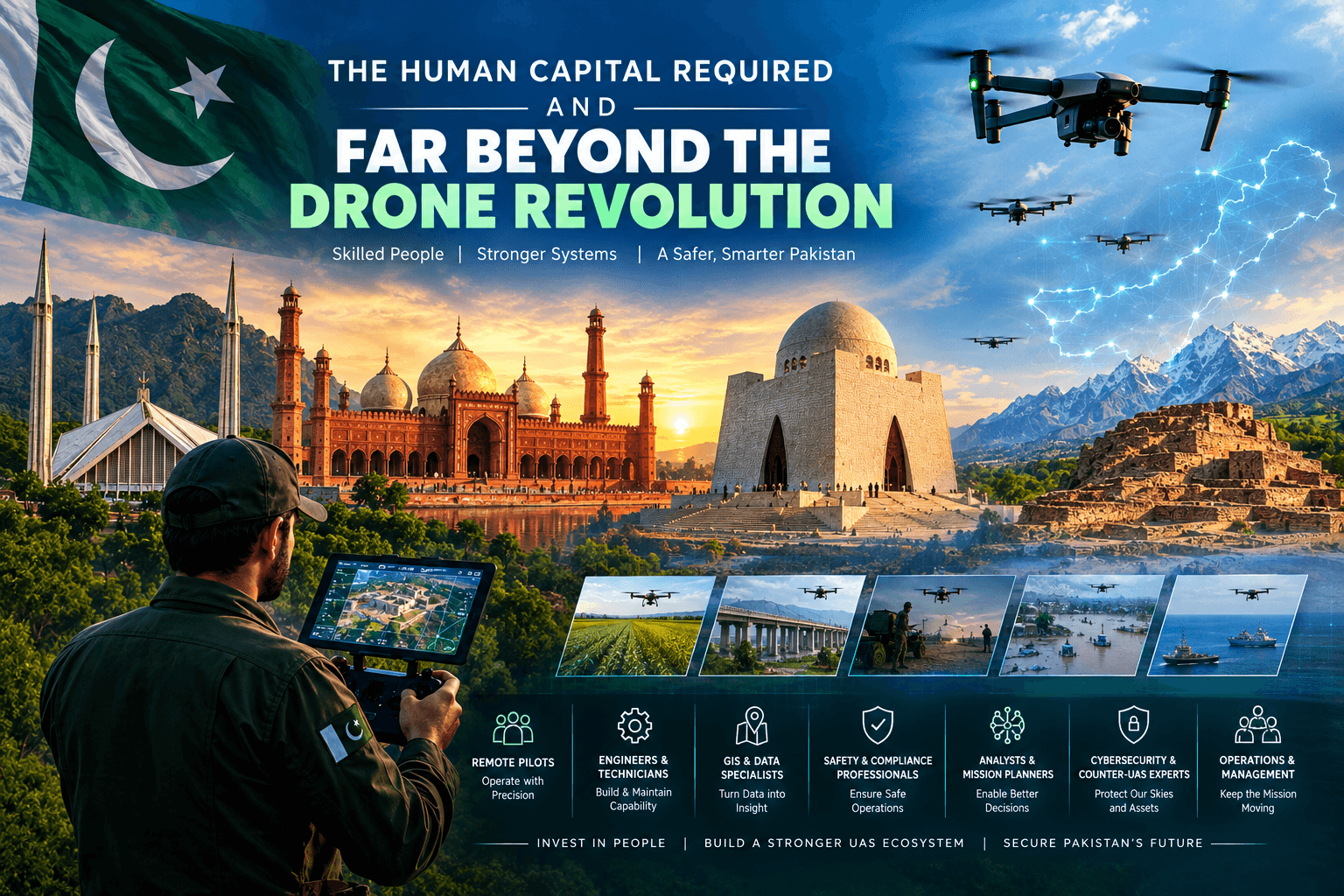
A professional Drone organization may require:
· Remote Pilots
· Drone Mission Commanders
· Mission Planners
· Flight Instructors
· Drone Maintenance Technicians
· Payload Specialists
· GIS and Mapping Specialists
· Remote-Sensing Professionals
· Data Analysts
· Drone Safety Managers
· Compliance Officers
· Airspace Coordinators
· Drone Cybersecurity Specialists
· Counter-DRONE Professionals
· Drone Operations Managers
· Drone Systems Engineers
This is effectively the emergence of a new branch of the aviation workforce.
The aircraft may be unmanned, but the ecosystem is not.
Why This Matters for Pakistan?
Pakistan is already moving toward a broader domestic Drone ecosystem.
In May 2026, the Ministry of Defence Production conducted an industry engagement with private-sector DRONE developers, highlighting the growing importance of drones in warfare, intelligence gathering, border monitoring and precision operations. The ministry also identified regulatory procedures, testing infrastructure, procurement mechanisms and research support as important elements of a sustainable domestic drone ecosystem.
This is significant because it demonstrates that the discussion is moving beyond individual drone platforms toward an ecosystem.
And every ecosystem requires people.
If Pakistan develops domestic drone manufacturing but lacks sufficient engineers, technicians, test personnel, operators, analysts, instructors and compliance professionals, the industrial base will remain constrained.
Likewise, if universities produce graduates in general engineering and computer science but do not expose them to aviation, drone operations and unmanned-systems applications, an important part of the future technology workforce will remain underdeveloped.
The Civilian Drone Economy
The civilian opportunity is enormous.
Pakistan's geography and economic structure create applications for DRONE across agriculture, infrastructure, construction, energy, environmental monitoring, disaster management, surveying and logistics.
Agriculture is an obvious example.
Drone can support aerial surveying, crop monitoring, mapping and remote sensing. Pakistan's technical training ecosystem already recognizes applications involving GIS, photogrammetry, thermal sensing, LiDAR, multispectral imaging and agricultural mission planning.
But operating a drone for professional agricultural work is fundamentally different from flying a recreational aircraft.
The professional operator must understand aviation safety, mission planning, sensors, geospatial information, data processing and the specific requirements of the agricultural application.
The same principle applies to infrastructure.
A drone inspecting a bridge, power facility, construction project or industrial site is effectively an aviation-based data-collection system.
The value is not merely the aircraft.
The value is the information generated by the mission.
This creates demand for professionals who can transform aerial data into useful engineering, agricultural, environmental or commercial decisions.
Pakistan's Low-Altitude Economy
The future drone sector should also be understood as part of an emerging low-altitude economy.
Drones can become platforms for services rather than simply products.
· A company may own a fleet but outsource mission planning
· Another organization may specialize in aerial surveying
· Another may process drone imagery
· A university may provide drone training
· A technical institute may train maintenance personnel
· A specialist company may provide regulatory and compliance services
This creates an ecosystem similar to conventional aviation, where airlines, MRO organizations, airports, regulators, training organizations, manufacturers and service providers operate around the aircraft.
The drone industry is heading in the same direction.
Pakistan therefore has an opportunity to develop not merely a drone market, but a DRONE services industry.
The Military Dimension
The military dimension makes the workforce question even more important.
Modern warfare has demonstrated that unmanned systems are increasingly integrated into surveillance, reconnaissance, intelligence, situational awareness, communications, targeting support, logistics and other military functions.
The important change is conceptual.
The drone should no longer be considered an isolated aircraft.
It is a component of a wider system involving:
Platform → Sensors → Communications → Operators → Data → Analysis → Command and Decision-Making
This means that the effectiveness of a drone capability depends upon far more than aircraft performance.
It depends upon the people and systems surrounding the aircraft.
A capable DRONE workforce therefore becomes an element of national technological resilience.

Aviation professional, Strategic business development practitioner
Noor Abbas Mirza
Writer
Aviation professional, strategic business development practitioner with experience spanning Aerospace & Defense Procurement, AVSEC, INFOSEC, CyberSEC, Quality, Compliance & Due Diligence Management