Industry
Who Owns the Plane? Understanding VIP Flights in Pakistan
A VIP flight does not make an aircraft a politician’s personal property. Understanding Pakistan’s government aviation framework helps separate public assets, official state travel, and private ownership from the assumptions often made on social media.
Noor Abbas MirzaAviation professional, Strategic business development practitioner18 Oct 20266 min read
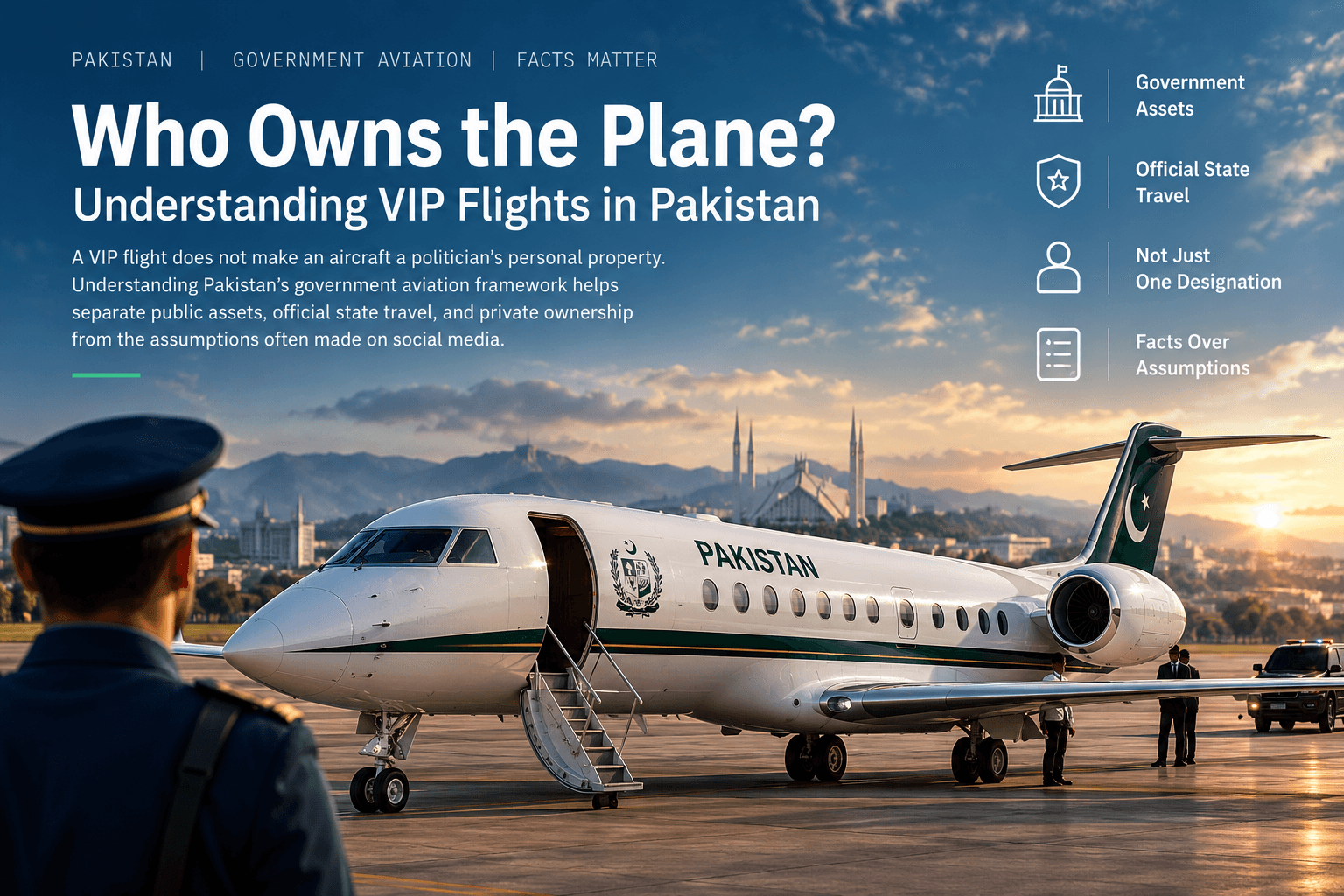
A government owned, registered, maintained and operating aircraft is not a politician’s personal aircraft. Understanding the difference between private ownership, government aviation, and official state travel is essential to understanding how VIP flights operate in Pakistan.
Whenever a government aircraft is spotted at an airport or a VIP flight appears on social media, a familiar question often follows: Whose plane is this? Is it the Prime Minister’s aircraft, the President’s plane, or a personal aircraft belonging to a politician?
The answer is not always as simple as the headlines or social media discussions suggest. To understand the subject, the public needs to distinguish between personal aircraft ownership, government-owned aviation assets, and the official arrangements used to transport state officials.
A Government Aircraft Is Not a Politician’s Personal Property
In Pakistan, it is important not to assume that a politician personally owns an aircraft simply because it is used to transport them. An aircraft operated for official government duties may be a state asset, managed through a designated government organisation or aviation arrangement. Its use does not automatically establish personal ownership by the person travelling onboard.
The distinction is similar to that between a government vehicle and a private car. A government minister may travel in an official vehicle, but that does not make the vehicle their personal property. Likewise, an aircraft used for an official visit does not become the personal aircraft of the official travelling in it.
Aircraft ownership, operational control, funding, maintenance responsibility, and passenger eligibility are separate matters. The specific arrangements depend on the aircraft and the organisation responsible for its operation.
What Is the Role of VIP Flight Departments?
VIP flight operations exist to support official state travel. Their purpose is not necessarily to serve one individual or one constitutional office exclusively. Depending on the applicable arrangements, aircraft and aviation support may be used to facilitate the official duties of different authorised state officials.
Such travel may involve constitutional officeholders, senior government officials, or other authorized representatives travelling for official engagements. The nature of the assignment, applicable protocols, security requirements, aircraft availability, and government procedures determine the arrangements.
The term VIP flight describes the nature of the transport mission; it does not, by itself, identify the owner of the aircraft or prove that the aircraft is permanently assigned to a particular person.
It is also important to understand that VIP flight operations are not necessarily a single, universal department serving every official in Pakistan. Different government and state organizations may have distinct aviation assets, operating arrangements, and responsibilities.
Is a VIP Aircraft Reserved for One Designation?
Not necessarily. An aircraft may be associated with a particular office because of its official role, but that does not mean every aircraft used for VIP transport is exclusively reserved for one designation.
Official aviation support can be organized around the requirements of state functions rather than the personal preferences of a particular officeholder. Depending on the applicable rules and operational arrangements, an aircraft may support different authorized missions at different times.
For example, an aircraft used for one official delegation today may support another authorized government mission on a subsequent occasion. This is a general illustration of how shared government transport assets can be used; it should not be taken as confirmation that every VIP aircraft in Pakistan is interchangeable or available to every official.
The key question is not simply who is sitting inside the aircraft? It is also which organization operates or controls the aircraft, under what authority is it being used, and what is the purpose of the flight?
Why Do State Officials Need Dedicated Aviation Support?
Official travel is not always equivalent to ordinary passenger travel. State officials may have demanding schedules, multiple engagements, security considerations, and responsibilities that require coordinated transport arrangements.
Government aviation can support time-sensitive official visits, intergovernmental meetings, diplomatic engagements, and other authorized state assignments. Depending on the mission, the arrangements may also involve security coordination, ground handling, flight planning, maintenance, and other technical and operational functions.
These requirements explain why governments maintain or arrange access to specialized transport capabilities. However, the existence of such capabilities does not automatically justify every expenditure or establish that every flight is necessary. The use of public resources remains a legitimate subject for questions about transparency, operational necessity, and accountability.
Who Pays for These Flights?
This is where the discussion requires particular care. The funding arrangements for a government-operated or government-arranged flight depend on the aircraft, the operating organization, the purpose of the journey, and the applicable rules.
A flight conducted for an official state assignment may be funded through public resources or an authorized government arrangement. A privately owned aircraft, by contrast, may operate under entirely different financial and contractual arrangements.
The public should therefore avoid assuming that every VIP flight is privately funded, or that every flight involving a politician is necessarily charged to the government in the same way. Determining the actual cost and funding source requires reliable information about the specific flight and its operating arrangements.
It is entirely reasonable for citizens and journalists to ask whether a journey was official, whether the expenditure was properly authorized, and whether the relevant rules were followed. These are questions of public accountability, not merely political preference.
Why Social Media Often Creates Confusion
Aircraft photographs, flight-tracking screenshots, airport videos, and short social media posts rarely provide the complete context of an official flight.
A photograph may show an aircraft carrying a senior official, but it does not establish who owns it. A flight-tracking record may identify an aircraft registration or route, but it does not necessarily reveal the mission's authorization, funding source, passenger eligibility, or official purpose.
Similarly, an aircraft informally described as the “Prime Minister’s plane” or the “President’s plane” may be labelled that way because of its association with an office or a particular journey. Such descriptions should not be treated as definitive evidence of legal ownership or exclusive assignment.
Responsible reporting requires checking the aircraft's ownership and operator, the relevant official records, and the context of the journey before drawing conclusions.
The Difference Between Criticism and Misinformation
Public expenditure and the use of government resources deserve scrutiny. Citizens have every right to question the cost of official travel, the frequency of VIP flights, the necessity of particular journeys, and the effectiveness of public spending.
However, criticism is strongest when it is based on verifiable facts. Claiming that a politician personally owns an aircraft merely because they travelled on it can misrepresent the situation. Equally, describing an aircraft as a state asset without verifying its ownership and operating arrangements can also be misleading.
A balanced discussion should distinguish three separate questions: who owns or controls the aircraft, who is authorized to use it, and who pays for the flight. The answers may be related, but they are not necessarily identical.
Understanding the Bigger Picture
VIP aviation should be understood as part of a country's broader system of official transport and state support. It is not simply a matter of identifying a politician and assigning an aircraft to them.
In Pakistan, the appropriate way to assess a particular VIP flight is to establish the aircraft's actual ownership or operating arrangement, identify the official purpose where that information is available, and examine the relevant rules and expenditure records.
The next time an official aircraft appears in the news, one question is worth asking before making assumptions: Is this a privately owned aircraft, a government-operated aircraft, or an aircraft arranged for an official state mission?
That distinction matters. It helps the public separate political rhetoric from verifiable information and makes discussions about government aviation more informed, fair, and accountable.

Aviation professional, Strategic business development practitioner
Noor Abbas Mirza
Writer
Aviation professional, strategic business development practitioner with experience spanning Aerospace & Defense Procurement, AVSEC, INFOSEC, CyberSEC, Quality, Compliance & Due Diligence Management