Geopolitics
When Aviation Becomes Part Of International Conspiracies
Commercial aviation is built around an unusually powerful idea: movement without borders. An aircraft can cross several countries in a matter of hours, carry hundreds of people, operate under a civilian registration, use ordinary airports and appear in schedules alongside thousands of completely routine flights.
Noor Abbas MirzaAviation professional, Strategic business development practitioner09 Oct 20266 min read
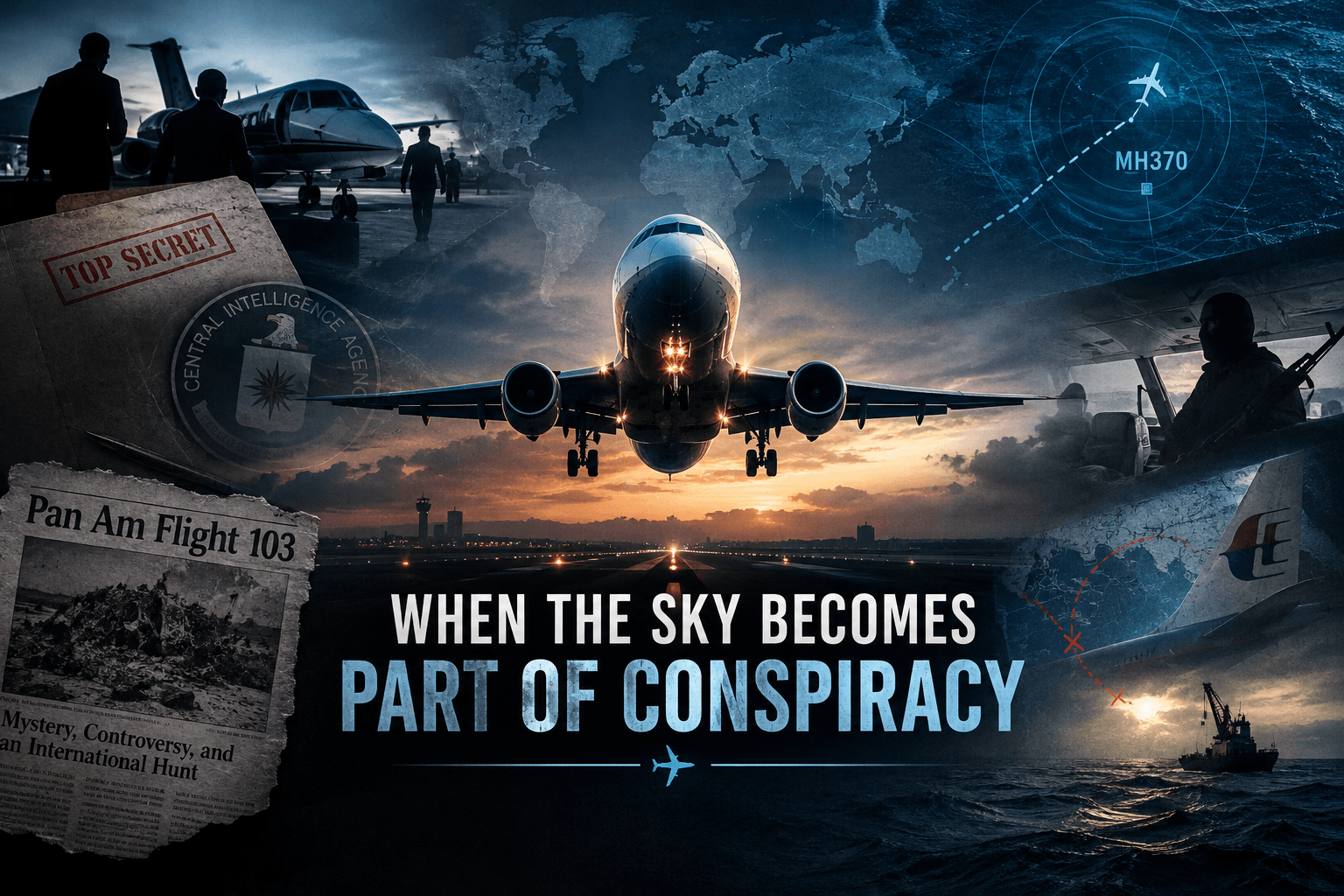
Commercial aviation is built around an unusually powerful idea: movement without borders. An aircraft can cross several countries in a matter of hours, carry hundreds of people, operate under a civilian registration, use ordinary airports and appear in schedules alongside thousands of completely routine flights.
That makes civil aviation more than a transportation system. Historically, it has also become part of intelligence operations, covert activity, political crises, terrorism and, inevitably, conspiracy theories.
Some of the stories surrounding aircraft are genuine conspiracies in the literal sense: secret arrangements that were later documented. Others remain disputed theories with incomplete evidence. The distinction matters. Aviation is particularly vulnerable to speculation because a single aircraft can connect governments, intelligence agencies, private companies, airports, passengers and international jurisdictions.
The history of aviation therefore offers an important lesson: sometimes the extraordinary story is true, sometimes it is partly true, and sometimes an ordinary aviation event becomes extraordinary only after people begin connecting unrelated pieces of information.
The Airline That Really Was a CIA Operation
One of the clearest historical examples is Civil Air Transport, later associated with Air America.
To the public, Civil Air Transport appeared to be a commercial airline. Behind the scenes, however, the CIA acquired the airline's assets in 1950 through an intermediary and used it as an aviation capability for covert operations. The CIA itself has subsequently declassified extensive material concerning the relationship.
Air America subsequently became deeply involved in American operations in Southeast Asia. Its aircraft transported personnel and supplies, evacuated refugees, conducted medical evacuations and supported covert and paramilitary activities. CIA historical material describes the airline as a vital component of operations in Laos.
This is an important distinction when discussing “conspiracies.”
There was no need for speculation. What once looked like a conspiracy theory became documented history after classified records were released.
The case also demonstrates why commercial aviation can be attractive for covert activity. An airline possesses aircraft, pilots, maintenance infrastructure, logistics networks, international operating experience and access to civilian airports. It provides an existing aviation ecosystem rather than requiring an entirely new one.
When a Civilian Airliner Becomes a Strategic Object
The Korean Air Lines Flight 007 tragedy in 1983 demonstrates another dimension.
KAL 007 was a scheduled civilian flight that entered Soviet airspace and was shot down by a Soviet fighter, killing all 269 people aboard. Contemporary U.S. government records show how rapidly the incident became intertwined with the wider Cold War confrontation.
The aircraft was civilian, but the strategic consequences were anything but civilian.
The incident generated competing narratives concerning what had happened, why the aircraft had entered Soviet territory and whether intelligence activity was involved. U.S. officials themselves anticipated Soviet attempts to shape the information environment surrounding the incident. A contemporaneous National Security Council memorandum even discussed the possibility of Soviet disinformation concerning the aircraft's alleged purpose.
This is where aviation and geopolitics become particularly complicated.
An aircraft does not have to be secretly operated by an intelligence agency to become part of an intelligence confrontation. Its route, location, communications, passengers and final destination can all acquire strategic significance.
Lockerbie: Aviation, Intelligence and an International Investigation
Pan Am Flight 103 became another defining example.
On 21 December 1988, the Boeing 747 operating the flight was destroyed over Lockerbie, Scotland, killing 259 people aboard and 11 people on the ground. The investigation eventually developed into a highly complex international criminal and diplomatic affair. Scottish and UK records document the investigation, subsequent prosecution and continuing legal controversy surrounding the case.
One particularly revealing aspect is the aircraft's baggage chain.
Investigators reconstructed how a suitcase could travel through multiple airports before reaching the Pan Am aircraft. Scottish court records describe evidence concerning baggage travelling from Malta to Frankfurt, then connecting with the Pan Am flight before continuing to London and ultimately Flight 103.
This illustrates a fundamental characteristic of international aviation: an aircraft is part of a much larger network.
Passengers, checked baggage, cargo, security screening, airline systems, airport personnel, immigration authorities and air-navigation systems all create interconnected chains. A conspiracy involving aviation therefore does not necessarily require control of the aircraft itself. Manipulating one component of the wider system can potentially have consequences far beyond the airport where the manipulation occurred.
MH370: The Disappearance That Created a Global Conspiracy
Few modern aviation mysteries have generated as many theories as Malaysia Airlines Flight MH370.
On 8 March 2014, the Boeing 777 operating MH370 from Kuala Lumpur to Beijing disappeared with 239 people aboard. The aircraft's disappearance became one of the most extensive aviation searches in history, involving multiple countries, aircraft, ships, satellites and enormous quantities of technical data.
Unlike many historical conspiracy stories, MH370 presents a particularly difficult problem: there is a substantial amount of evidence, but the central question remains unresolved.
Investigators established that MH370 did not simply vanish from the aviation system. Military radar and satellite communications provided information about the aircraft's subsequent movements, while satellite data was used to establish a broad area in the southern Indian Ocean where the aircraft was believed to have ended its flight. Debris subsequently identified as originating from MH370 was also recovered from islands and coastlines around the Indian Ocean.
The Aircraft That Carried People Nobody Was Supposed to See
After the September 11 attacks, another controversial aviation story emerged: extraordinary rendition.
The concept itself was not imaginary. U.S. government records document the existence of extraordinary rendition as a counterterrorism practice, while congressional investigations examined the CIA's detention and interrogation program.
Aircraft associated with private companies subsequently attracted considerable attention from investigators and human-rights organizations.
One extensively documented aircraft, registered at different times as N313P and N4476S, was tracked through hundreds of movements. Amnesty International's research identified the aircraft in connection with the transfer of detainees and examined its corporate ownership and flight history.
This case is particularly significant because it demonstrates how an apparently ordinary business aircraft can become relevant to an intelligence investigation.
The aircraft does not necessarily carry an intelligence-agency logo.
It may be registered to a private company.
It may appear in civilian aviation databases.
It may use ordinary airports.
And yet its movements, ownership structure and passengers can become pieces of a much larger intelligence picture.
This is one reason aircraft tracking has become so significant in investigative journalism and open-source intelligence.
The Hijacked Airliner as a Political Weapon
There is another category entirely: when conspirators deliberately use commercial aviation as the mechanism of an operation.
The December 1994 hijacking of Air France Flight 8969 demonstrated the possibility of using a civilian aircraft as more than a means of transportation. U.S. congressional records examining pre-9/11 intelligence specifically cite the incident and note that the hijackers threatened to crash the aircraft into the Eiffel Tower. French authorities ultimately diverted the aircraft and conducted an assault at Marseille.
The significance of such incidents extends beyond the individual event.
A commercial airliner represents a concentration of people, infrastructure, political symbolism and international attention. Consequently, an aircraft can become a strategic instrument even when the aircraft itself has no military characteristics.
September 11, 2001 subsequently demonstrated the most consequential manifestation of this principle, when terrorists used hijacked commercial aircraft as weapons. A U.S. congressional inquiry later documented that intelligence agencies had received reporting concerning the potential use of aircraft in terrorist operations before the attacks, although it did not identify a specific prediction of the September 11 operation.
The Sky Has Always Been More Than Transportation
Commercial aviation was designed to move people and goods across borders.
But history has repeatedly demonstrated that aircraft can become instruments of diplomacy, intelligence, terrorism, covert logistics, political signaling and international confrontation.
Some of the most extraordinary aviation stories were once dismissed as unbelievable and later confirmed through declassified records. Civil Air Transport's relationship with the CIA is perhaps the clearest example.
Other stories remain contested.
And some are simply conspiracy theories built around incomplete information.
The challenge for the modern aviation enthusiast is therefore not to believe every conspiracy—or to dismiss every conspiracy.
It is to investigate.
Because aviation leaves a trail.
Sometimes that trail leads to an ordinary flight.
Sometimes it leads to a government operation.
And occasionally, when enough historical records are finally opened, it leads somewhere that almost nobody expected.

Aviation professional, Strategic business development practitioner
Noor Abbas Mirza
Writer
Aviation professional, strategic business development practitioner with experience spanning Aerospace & Defense Procurement, AVSEC, INFOSEC, CyberSEC, Quality, Compliance & Due Diligence Management