Geopolitics
From Manga to Bushido — Military resurgence of Japan amid a rude awakening
Washington's security umbrella has covered Japan for seventy-five years. With no US carrier left in the Indo-Pacific, Tokyo has decided to stop relying on it
Arslan Baloch09 Sept 20264 min read
From Manga to Bushido
Military resurgence of Japan amid a rude awakening
For around 3 quarters of a century, American security umbrella has been shielding Japan but recent conflict in the middle east has not only threatened Japan’s energy security but also its absolute security as the United States keeps pulling out valuable offensive and defensive assets out of Indo-Pacific to replenish American and Israeli forces in Middle East.
Being a treaty ally of the United States, Japan has come to realization that when push comes to shove with regards to China, North Korea and Russia, Japan may not enjoy much tactical and strategic support from its most powerful ally i.e., the US, on account of being militarily overstretched by being bogged down in Middle East and logistically handicapped on account of supplying Ukraine against Russia with production capacity found lacking.
As the conflict rages on, US has already pulled out a significant number of THAAD and PAC-3 interceptor units from South Korea and the wider Indo-Pacific (Arms Control Association; UPI). The scale of the drawdown is best measured by consumption: the Pentagon expended more than 1,200 Patriot interceptors during the war with Iran, leaving inventories worryingly low. Recently, USS George Washington left for Middle East to relieve USS Abraham Lincoln off operation to provide much needed respite for American Sailors for being operationally engaged with Iran for 280 days, leaving the entire Indo-Pacific region without a single US aircraft carrier (Stars and Stripes; TWZ), leaving Japan uneasy about its own security. This is not a one-off gap: analysts note that if two carriers remain committed to the Middle East, Pacific presence will fall to zero for months of each year (Axios).
American Carrier left for Middle east, an interesting development towards the north of Japan. The Russian president Vladimir Putin visited the disputed Kuril Islands (CNN) followed by a series of live ballistic, cruise and anti-ship missile launch exercises from these islands (The Japan Times; Stars and Stripes), adding to the woes of Japan while dealing with disputed status of Takeshima Island with South Korea, another fellow ally, and Senkaku Islands with China towards the south.
In August this year, Japan’s ministry of Defence has requested a sum of at least $55 billion to mitigate the security threats the island nation faces (USNI News; The Japan Times). Experts are already calling it record breaking as Japan has already achieved its goal of 2% of the GDP towards defence spending ahead of proposed timeline of 2027, which only shows the seriousness of Japan to take the challenges head-on instead of relying too much on the US. The figure may yet grow: around 160 entries in the request carry no assigned funding pending a revision of Japan’s three key security documents, making it an opening bid rather than a final one (The Diplomat).
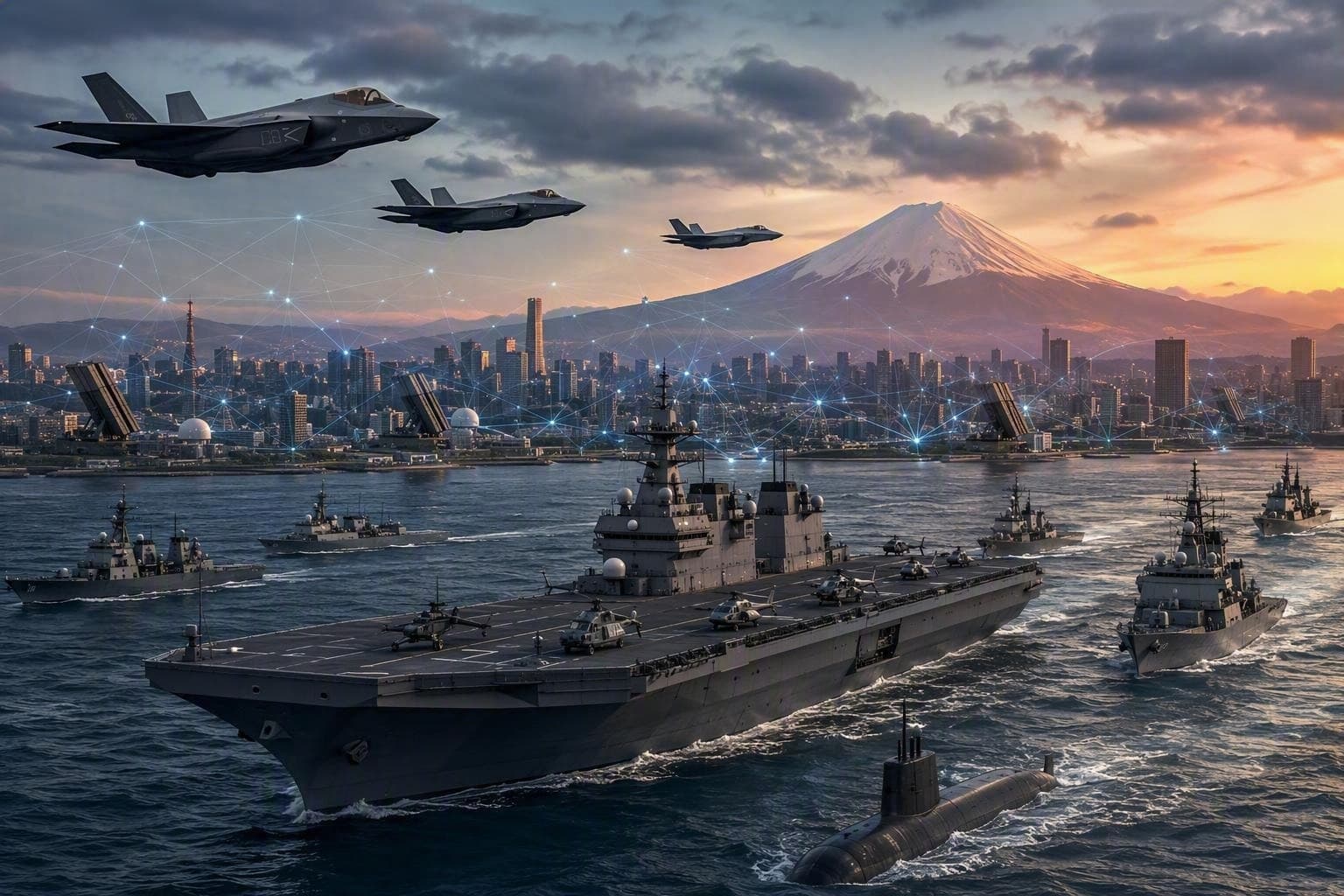
Japanese Self Defence Force may not rival the Imperial Japanese Armed Forces, but it surely is turning up the heat by inducting high tech American and indigenous platforms across all domains. Whether it is the Izumo Class carrier masquerading as a destroyer or Mogami class frigate, not to mention the ship mounted experimental electromagnetic hypersonic rail guns, Japan has not only been committing to qualitative Research and Development for kinetic and non-kinetic capabilities, but also been focussing on capacity building for sustainable operations in the face of any eventuality it may face. While the world focussed on a large Japanese order of Tomahawk Cruise Missile to the US, Japan has recently fielded a long-range air launched anti ship cruise missile with an air-to-air missile also in the development pipeline (Naval News). Moreover, Japan is also competing against other allies to win shipbuilding contracts for US Navy under the “Finland Model” approach of Pentagon to alleviate the low production rate of American shipbuilding industry in light of dwindling US Navy numbers.
One could easily argue that the soft power champion of the world, the land of high-tech gadgets, manga and anime is turning back to the old ways of Bushido, valuing the strength of steel to protect its interests as American allies may be handicapped at best for having fingers in every pie, and unreliable at worst for prioritizing other allies over Japan, leaving the island nation high and dry, should any crisis emerge in the Indo-Pacific, hence counting on its own strength primarily to take the driving seat with the US taking the role of a “side kick”. Some geo-strategic pundits at Washington must be wondering why they were backing India as a bulwark against China instead of Japan with a more expansive and assertive role backed by a cutting edge 21st century fighting force.
Sources
• USNI News — Japan Budget Requests Record $55.6B for Unmanned, Long Range Strike Capabilities
• The Japan Times — Defense Ministry’s record ¥8.9 trillion budget request
• The Diplomat — Japan’s Record 2027 Defense Budget Request Is Only the Opening Bid
• Naval News — Japan’s Record FY2027 Budget Request: New FFM, ASEV & Submarines
• Stars and Stripes — USS George Washington headed to Middle East to relieve USS Abraham Lincoln
• TWZ — Where Are The Aircraft Carriers?: August 17, 2026
• Axios — Middle East war forces U.S. aircraft carrier shift from Pacific
• CNN — Japan condemns Putin’s visit to disputed islands seized in World War Two
• The Japan Times — Russia holds rare missile test near islands claimed by Japan
• Stars and Stripes — Russian missile drills near disputed islands deepen tensions with Japan
• Arms Control Association — U.S. Moves Missile Defenses to Middle East
• UPI — U.S. Patriot shortage raises air-defense concerns in South Korea

Arslan Baloch
Writer
Arslan Baloch has a background in engineering and a keen interest in aerospace and geopolitics. He runs a blog on these topics too, namely TheArmamentChronicle.