Analysis
The F-4 Phantom Fallacy: Why the “Drone Revolution” Is Being Overstated
Every generation declares the manned fighter obsolete. The F-4 was supposed to be the last one and the drone argument is making the same mistake.
Sqn Ldr (R) Ali HamzaFormer Military Aviator02 Sept 20265 min read
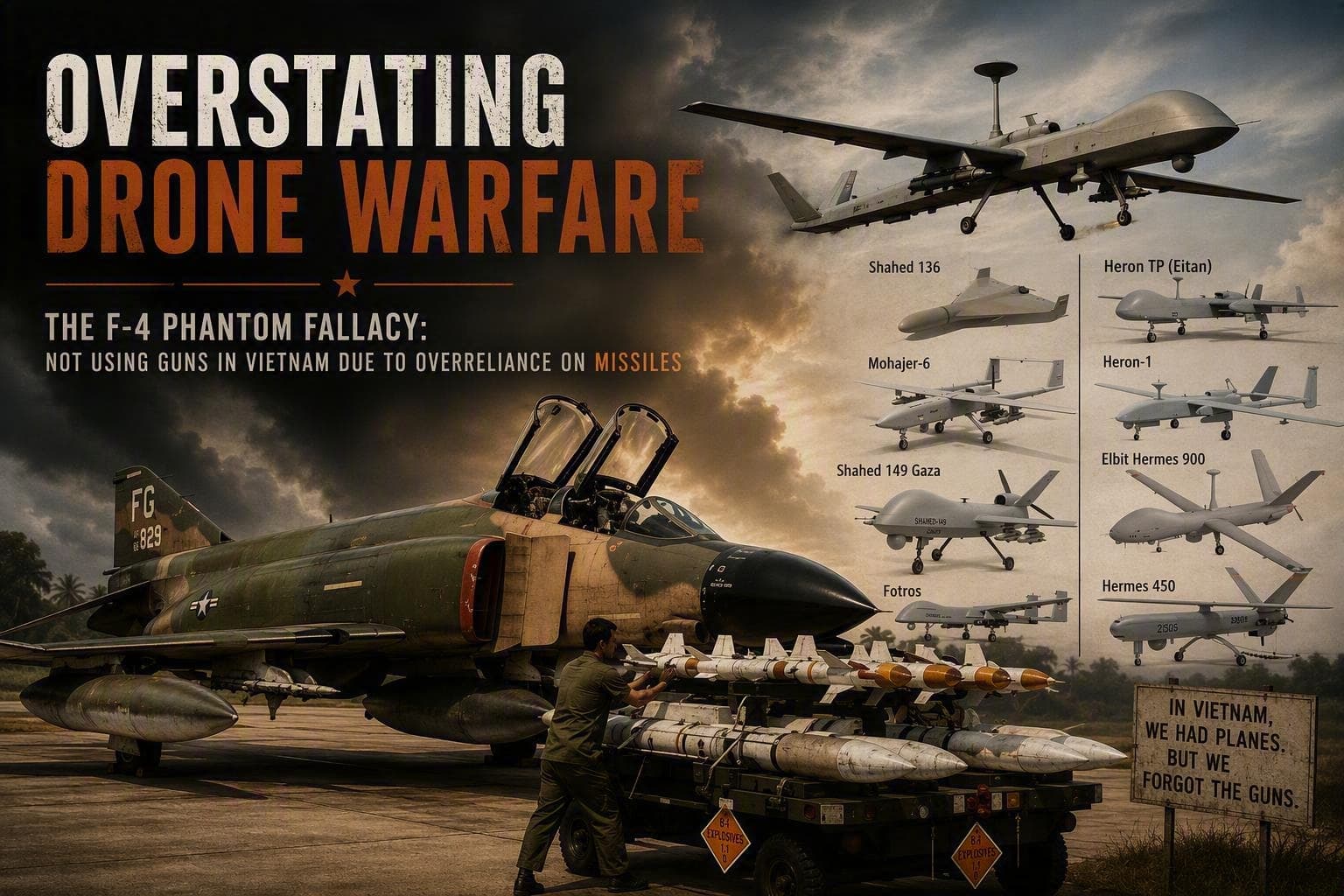
There is an old lesson in air combat that every serious airman should remember: never fall in love with technology so much that you forget the basics of war. The F-4 Phantom is one of the clearest examples of this mistake. In the 1960s, many planners believed the age of close-in dogfighting was over. Missiles were supposed to do the killing from beyond visual range, and the gun was treated like a relic of the past. Then Vietnam happened. Missiles missed, rules of engagement forced pilots into visual combat, and suddenly aircrews found themselves in turning fights without the one weapon they badly needed: a cannon.
That lesson still matters today. The current excitement around drones has created a similar temptation. Because UAVs have performed impressively in recent conflicts, some observers are rushing to declare tanks, crewed aircraft, and traditional military platforms obsolete. But that kind of thinking is dangerous. It repeats the same error made with the Phantom: assuming that one new technology can rewrite the nature of war by itself.
There is no doubt that drones have changed the battlefield. Anyone who watched the 2020 Nagorno-Karabakh war saw how effectively Turkish Bayraktar TB2s struck Armenian armor, air defenses, and logistics. The footage was dramatic, clean, and convincing. In Ukraine, FPV drones, loitering munitions, and cheap commercial systems have made precision strike available at a scale that would have been unthinkable a decade ago. Small teams can now find, track, and destroy vehicles with systems that cost a fraction of the target. That is a serious development, and no professional military can afford to ignore it.
But there is a big difference between being tactically useful and being strategically decisive. A drone destroying a tank on video does not automatically mean the tank is finished as a military instrument. A loitering munition hitting a radar does not mean traditional airpower is dead. War is not decided by short clips on social media. It is decided by endurance, adaptation, logistics, command and control, training, morale, and the ability to integrate effects across domains.
What the drone footage usually does not show is the invisible machinery behind every successful strike. Drones need operators, frequencies, batteries, launch teams, targeting data, communications links, maintenance chains, and intelligence support. More importantly, they need access to the electromagnetic spectrum. Once that spectrum is contested, the drone’s advantage can shrink very quickly. In Ukraine, both sides have learned this the hard way. A frequency or control method that works today may be jammed, spoofed, or hunted tomorrow. The fight has become a constant race between drone operators and electronic warfare teams.
This is where many “drone revolution” arguments become too simplistic. They focus on the kill, but not on the counter-kill. Militaries are already adapting. Counter-UAS systems are improving. Electronic warfare units are learning faster. Air defenses are becoming more layered. Kinetic interceptors, directed energy, cyber tools, radar cueing, and AI-assisted threat prioritization are all being pulled into the same defensive architecture. The result is not the end of traditional warfare, but the birth of a much more complex battlespace.
The same can be seen in the Middle East. Iran and its proxies have used drones and loitering munitions to create pressure at relatively low cost. Systems like the Shahed-136 show how cheap platforms can stretch an opponent’s defenses and impose economic and operational burdens. But they have not made modern air defense irrelevant. If anything, they have proved the opposite. They have shown that states need layered defenses, redundancy, early warning, and integration between air, land, maritime, cyber, and space-based assets.
In the Indo-Pak context, the lesson is even more important. UAVs will certainly play a growing role in ISR, border monitoring, targeting support, and limited offensive actions. They can harass, observe, confuse, and sometimes strike. But they are not a substitute for credible conventional deterrence. They cannot hold ground. They cannot generate air superiority on their own. They cannot replace trained pilots, hardened bases, integrated air defense, or the political weight carried by conventional forces. In a crisis between two nuclear-armed states, drones may shape the tempo, but they are unlikely to carry the full strategic burden.
From a pilot’s point of view, the real question is not whether drones matter. Of course they do. The question is whether they can replace the judgment, flexibility, payload, survivability, and decision-making of crewed platforms within a larger campaign. At present, the answer is no. A drone can be very effective in a narrow role, especially where air defenses are weak or where electronic warfare is limited. But in a serious contested environment, against an adaptive opponent, drones become one part of the fight rather than the whole fight.
The future of warfare is therefore not “drones versus everything else.” That is the wrong frame. The future belongs to integrated Multi-Domain Operations. Drones will work alongside fighter aircraft, ground forces, artillery, satellites, cyber units, electronic warfare platforms, and air defense networks. They will extend reach, reduce risk, improve targeting, and complicate enemy planning. But they will complement conventional forces, not replace them.
The F-4 Phantom story should remain a warning. The mistake was not adopting missiles. The mistake was believing missiles had made every previous lesson irrelevant. Today, the mistake would not be adopting drones. The mistake would be believing drones have made tanks, fighters, artillery, air defenses, and trained human judgment obsolete.
War has always punished fashionable certainty. A military that writes off traditional platforms because of a few dramatic battlefield examples may find itself in the same position as those early Phantom crews: committed to a fight, facing an adaptive enemy, and realizing too late that the “obsolete” capability it discarded was exactly the one it needed.
The drone age is real. But the drone revolution is not a replacement for strategy. It is a reminder that warfare evolves, and that the side which survives is not the one that worships technology, but the one that integrates it intelligently.

Former Military Aviator
Sqn Ldr (R) Ali Hamza
Editor-in-chief
Ali Hamza served in PAF for 20 years as a fighter and Instructor pilot, with a stint on helicopters. Choosing academia over commercial flying, he did his double masters in International Relations and Defence & Strategic Studies. Currently an MPhil IR scholar and CEO of AeronautIR Solutions, his research interest lies in espousing aerospace with geopolitics.