Aerospace
Tejas and JF-17's Comparison of Safety Record
Accident Rate is not Calculated in Years, but Hours Flown
Sqn Ldr (R) Ali HamzaFormer Military Aviator30 Aug 20265 min read
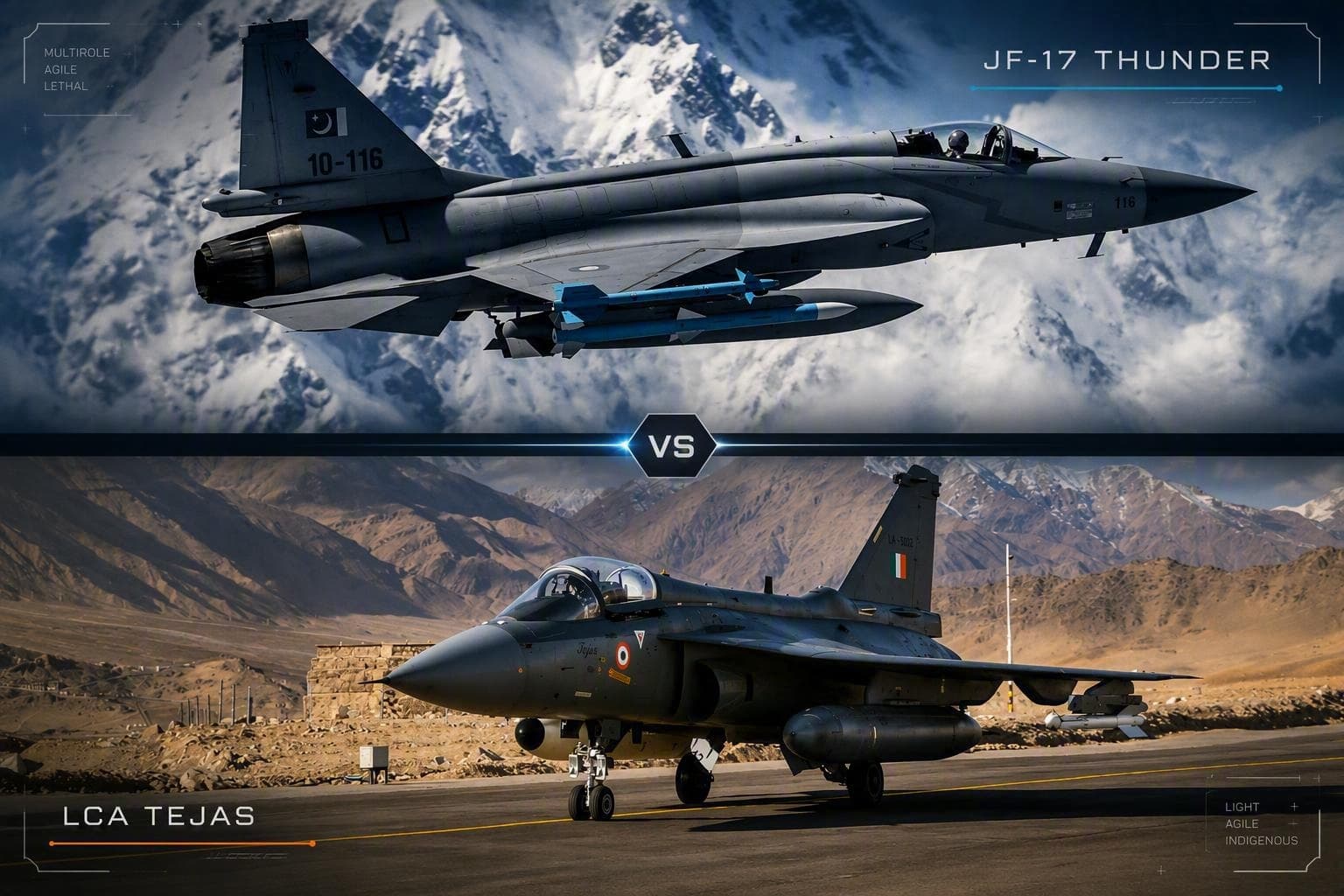
Tejas Crash at Dubai Airshow: An Isolated Incident or an Injustice to the Fallen Aviator?
“I never ‘worry’ about action, but only about inaction.”
Winston Churchill, Churchill By Himself
The above-mentioned quote is one of many like this Latin adage Facta, non verba, meaning deeds, not words, that emphasize on the importance of actions as words are easy and cheap without it. The myriad plethora of posts on social media by Indian accounts, not only ignorant masses but retired military officers, is an intellectually dishonest attempt to whitewash the Hindustan Aeronautics Limited (HAL) for their failure of Light Combat Aircraft (LCA) named Tejas. The tragic loss of life is sad and after paying heart-failed condolences for the deceased pilot Wg Cdr Namansh Syal who died in Tejas crash on 21 November during live aerobatics display at Dubai airshow. However, as a pilot, it enrages me how the Indian state machinery is trying to hide the issues with the machine and the common people are accepting the disinformation without looking at realities of deep systemic issues in the indigenous defence industry. The pilot may have made some errors but in the end, it was the underpowered aircraft that failed him and he lost his life, deserving the truth instead of current rhetoric.
I have made a video about the reasons for crash on my YouTube channel[1] and tweeted extensively on X (twitter) to convince many hostile Indians commenting on my posts that the deep-rooted problems are the root cause of this crash. However, after being unsuccessful, I decided to write this article after reading HAL’s statement[2] on 24 November regarding this crash being an “isolated incident” which was caused by “exceptional circumstances” with no other details. The LCA project started in 1983 and current Indian Air Force (IAF) inventory of combat capable Tejas is, with no deliveries expected this year, is 14 aircraft after 42 years of Aeronautical Development Agency (ADA) and HAL’s work which speak volumes about incompetence in this so-called success story. Last but not the least, the misinformation on social media like this tweet by a retired Indian Army colonel[3] is an attempt to disguise these failures by calling Tejas a “miracle” and giving supporting evidence as only 2 crashes in 24 years unlike hundreds of crashes of US made F-16. For facts, we need to dive deeper for calculating accident rate and safety record based on operational flying hours and not time spent on ground by aircraft.
The details about the probable cause of crash have been discussed in length already and there is a high probability of pilot error due to partial impairment, that led to dropping of nose well below horizon once aircraft war inverted after ‘Knife’s edge pass’ manoeuvre. Most probably, the pilot’s brain was deprived of oxygen when he shifted from negative G i.e. forward pressure on stick to a loaded roll which means positive G forces. This transformation may have resulted in loss of situational awareness for precious 1-2 seconds once the blood drained from his blood into vessels below the neck. At that altitude, losing 200-300 feet meant that his aircraft descended sharply towards ground and though he tried to pull away with wings level and nose high, control stick full back and centre for ailerons neutral, the <1 thrust-to-weight ratio of Tejas failed him there. Unlike a Spanish F-18 Hornet and Solo Turk F-16 that also got in a similar predicament but were able to fly away due to better aircraft performance, Wg Cdr Namansh unfortunately had Tejas as his steed and it could not help him out here. Lastly, a fly-by-wire system glitch cannot be ruled out and if pilot gave right inputs at right time, the response of aircraft may have been the cause of this fatal accident.
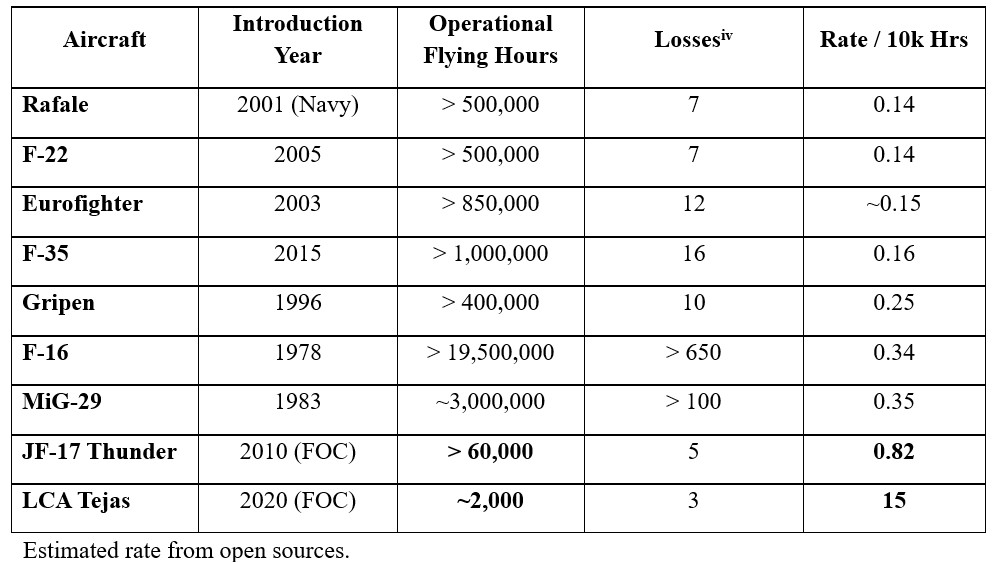
The first flight of LCA technology demonstrator (TD) prototype was in 2001, and Indians are claiming that Tejas has best safety record of all, better than F-16 and JF-17, as it has only seen 2 crashes in 24 years. A simple google search for the criteria to calculate accident rate will tell any layman that flight safety of a fleet is not based on time in years, but operational hours flown. Generally, it is 100,000 hours per crash, but I have made a table below based on 10,000 hours per loss. The data has been collected from open sources and even if some figures may not be exact, it is more or less accurate in the requirement of busting the myth of Tejas having the best safety record. Lastly, the claim of 12,000 hours for Tejas is not right because the first 4 Final Operational Clearance (FOC) aircraft were delivered to N0. 18 Squadron (sqn) of IAF in 2020, with 16 aircraft by end of 2021. With 2 of those aircraft now crashed within 5 years, only IAF can give the exact hours flown by this sqn but many sources claim the number to be 1,954 hours.
In the end, I just want to express my feelings of sympathy for the slain pilot and others flying this machine, meanwhile feeling angry about the fact that his death has been repudiated by the country as well as the organization for which he sacrificed his life. Even after he has paid the ultimate price for the blunders of policy makers in top brass of politics, military and bureaucracy, there is an ongoing campaign to hide the inadequacies of this aircraft and shortcomings of state machinery. While it was supposed to replace MiG-21 at least 3 decades back, the aircraft was already obsolete when the MiG was finally retired on 26 September 2025. To keep it relevant, several systems had to be added which resulted in a weight penalty that even a reliable engine like GE F-404 cannot handle in extreme conditions. The Indian Navy rejected Tejas for carrier operations due to multiple reasons, most importantly the similar underpowered and high weight issues. Last but not the least, the Indian Navy was forced to buy Dhruv helicopter manufactured by HAL and this article by first Dhruv sqn flight commander[4] says it all about poor work ethics culture of this company. RIP Wg Cdr Namansh Syal, may you get the justice you deserve.
Video link: https://youtu.be/ohkVQaYmXyw?si=JELTdlUbgwlEYyoQ ↑
Reuters, 24 November 2025, India's Tejas jet-maker HAL calls Dubai crash an isolated occurrence: https://www.reuters.com/world/india/indias-hindustan-aeronautics-calls-tejas-jet-crash-an-isolated-occurrence-2025-11-24/ ↑
Colonel Mayank Chaubey tweet about Tejas a miracle and its excellent safety record on 27 November 2025: https://x.com/col_chaubey/status/1993833709930467695?t=wf-WK-h8_StwipMCGfb5vg&s=08 ↑
The Truth Hurts, Says Indian Navy’s 1st Dhruv Flight Commander: https://www.livefistdefence.com/the-truth-hurts-says-indian-navys-1st-dhruv-flight-commander/ ↑

Former Military Aviator
Sqn Ldr (R) Ali Hamza
Editor-in-chief
Ali Hamza served in PAF for 20 years as a fighter and Instructor pilot, with a stint on helicopters. Choosing academia over commercial flying, he did his double masters in International Relations and Defence & Strategic Studies. Currently an MPhil IR scholar and CEO of AeronautIR Solutions, his research interest lies in espousing aerospace with geopolitics.